
Bonney Lake Directory Collections
The confirmed Bonney Lake shelf is small but useful. The city scrapbook points to a local business directory, a community handbook, maps, service guides, and a history guide. These sources are not a census of households. They can still identify local firms, public contacts, streets, groups, and names tied to civic life. Regional city directories add method and context, but Tacoma volumes must always be labeled as Tacoma sources.
| Collection | Years | Where held | Access |
|---|---|---|---|
| Bonney Lake Business Directory | 1985 | City scrapbook | Public city PDF; business listings, not households |
| Community Handbook and History Guide | 1993 and 1999 | City scrapbook | Public PDF table of contents and compiled material |
| Tacoma city directories | 1885-2021 | Tacoma Public Library Northwest Room and regional collections | Library or HeritageQuest; regional only |
| Federal census | 1790-1950 | HeritageQuest and archives | Historical images and indexes |
| Bonney Lake council minutes | 1949-present, with gaps | Washington Digital Archives | Online index and digitized images where available |
| GBLHS collection | Dates vary | Greater Bonney Lake Historical Society | Contact required; stable public catalog not located |
No official Bonney Lake-specific Polk, telephone, or reverse city directory run was found in the inspected sources. That gap matters. A careful search should use the confirmed local pieces first, then clearly mark any regional substitute.
Other dated collections can bridge missing directory years. HeritageHub reports obituary and death-notice coverage beginning in 1704, although the years available depend on the newspaper. Pierce County marriage returns carry a collection title of 1891-1938, while the description extends through 1950, so the image date must be checked. Federal census images through 1950 supply household snapshots under the public-release rule. None is a city directory, but each can test a name, relationship, or address found in the local material.
Inside Bonney Lake's Scrapbook
The Bonney Lake Scrapbook is the best local starting point for directory-like material. Its contents include the 1985 business directory, 1993 community handbook, 1999 history guide, 1952 and 1958 maps, ward maps from 1997 and 2002, and a 2006 citizen service guide. Articles continue through 2020.
Search names in the PDF, then inspect nearby pages. Optical text recognition can miss faint type, columns, and scanned clippings. A business name may lead to an owner, address, phone listing, event, or civic group. Save the item title and page number, since the scrapbook combines many sources created at different dates.
Bonney Lake Library Genealogy Tools
The Bonney Lake Branch at 18501 90th St E can connect local researchers with the Pierce County Library genealogy and history resources. The branch phone is 253-548-3308. HeritageQuest is offered through a library card, while Ancestry Library Edition is available inside library buildings. HeritageHub covers obituary and death notices, and Access World News adds newspaper searching.
The library pages do not promise a complete Bonney Lake city directory run. Ask staff about catalog holdings, database access, interlibrary loan, and referrals before making a trip for a specific volume. Microfilm readers are identified at Gig Harbor and Parkland/Spanaway for library-owned or borrowed material, not at every branch.
Choose the database by the question. HeritageQuest is useful for census work and scanned directories. Ancestry Library Edition adds broad indexed collections during an in-library visit. HeritageHub and Access World News are better when a name may appear in a death notice or news story. Save the publication title, date, page, and database name. A result that merely repeats a name without a matching place or date is too weak to merge into a Bonney Lake family timeline.
Read Bonney Lake Directory Evidence
A city directory entry is a dated listing, not proof of current residence or title. Older regional volumes may organize names by surname. Later Tacoma volumes also add address order. Always photograph or transcribe the title page and abbreviation key before interpreting a short entry.
| Name | The printed person or business name, including initials and spelling variants |
|---|---|
| Household detail | A spouse, widow notation, or other relationship only when the volume prints it |
| Work detail | An occupation or place of work in some historical volumes |
| Address | The street address shown for that directory date |
| Source mark | An abbreviation or symbol defined by that volume's own key |
- Criss-cross directory
- A directory arranged by street and house number instead of only by surname.
- Householder index
- An address-based list that points to the person printed at a dwelling.
- Abbreviation key
- The volume's guide to shortened terms and symbols. It controls how an entry should be read.
Regional City Directory Method
The Tacoma Northwest Room buildings guide documents a strong regional method. Tacoma directories run from 1885 through 2021. Volumes from 1885 to 1927 are arranged by surname, while those from 1928 onward include surname and address organization. This is evidence about Tacoma's collection, not proof of an equivalent Bonney Lake series.
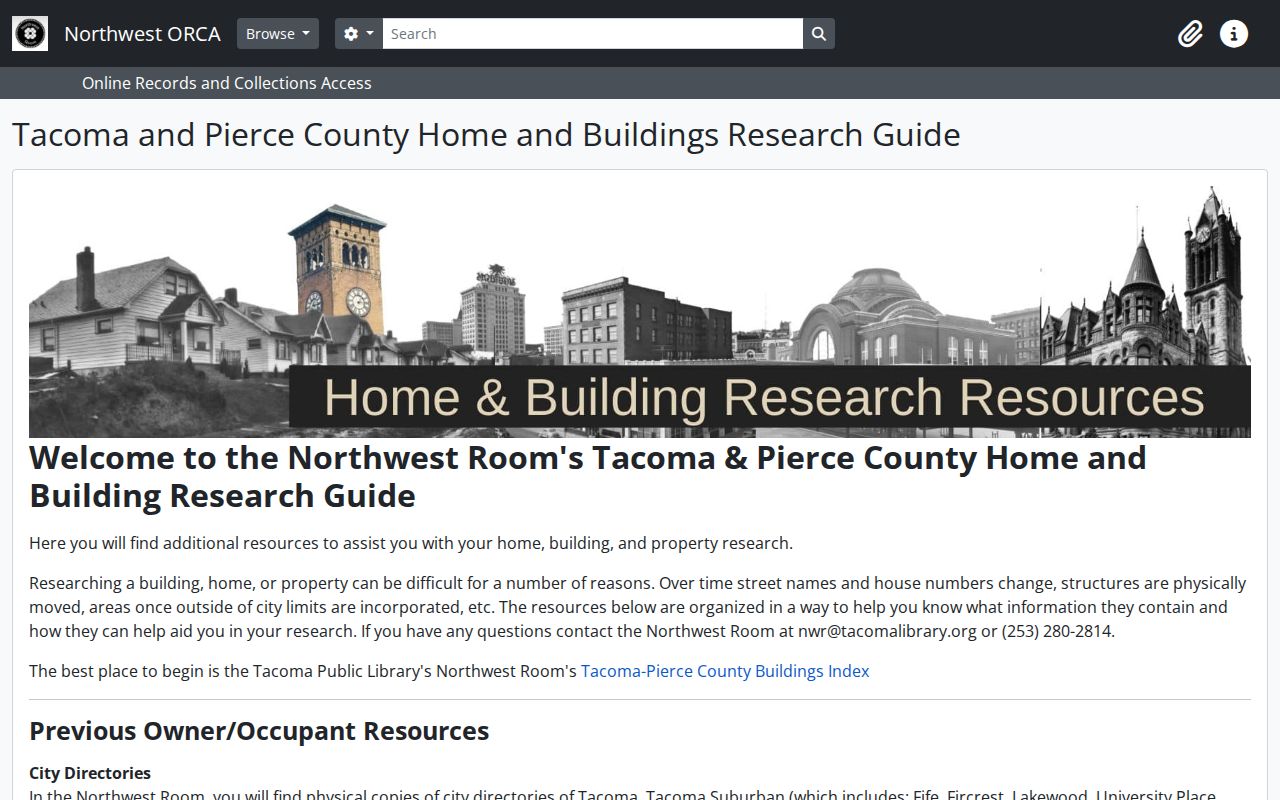
The captured guide shows where directory, census, assessor, and newspaper work can meet. Apply the method to Bonney Lake only when a source actually covers the person or place being studied.
A City Directory Evidence Chain
The Northwest Room's 810 N M St house-history entry is a regional sample of what a well-built chain can contain. It provides an address, an approximate construction date, images, a style label, occupant runs, and newspaper or obituary references. Its directory sequence spans 1891 to 1991. The address is in Tacoma, not Bonney Lake.
This sample shows why adjacent years matter. A name that appears for one year may be a short stay or a printing issue. A long run is stronger evidence of continuity, yet it still needs a deed, census, obituary, or other dated record before drawing conclusions about ownership or family ties.
The sample occupant trail includes a series of named households across many decades, along with photographs and building details. That mix demonstrates good source separation: a directory supports who was listed, a photograph supports how the building appeared, and a newspaper or obituary may explain a move or death. A Bonney Lake researcher should seek the same kind of agreement without importing the Tacoma names into local history. Regional examples teach a method; they do not fill a local evidence gap.
Trace Bonney Lake Family History
Build a timeline rather than collecting loose names. Start with one dated source, preserve its exact spelling, and move in small steps. When no Bonney Lake city directory exists for the target year, use the census, obituary databases, deeds, or municipal records without pretending they are directory entries.
- Choose a known name, address, and approximate year.
- Check the closest confirmed local directory-like source or regional volume.
- Copy every printed detail and the source citation.
- Compare nearby years, then pair the result with a census year.
- Test the identity against an obituary, probate file, deed, or council record.
A disappearance can mean a move, death, changed spelling, omission, or a source gap. The Bonney Lake resident lookup offers the modern one-person workflow when the search moves beyond historical collections.
Bonney Lake Minutes by Date
The Bonney Lake City Council Minutes can connect a name or place with municipal action. The series begins March 20, 1949. Its collection page identifies a gap from December 10, 1991 through January 5, 1999, apart from two meetings in 1998, and notes a missing page from January 14, 1959.
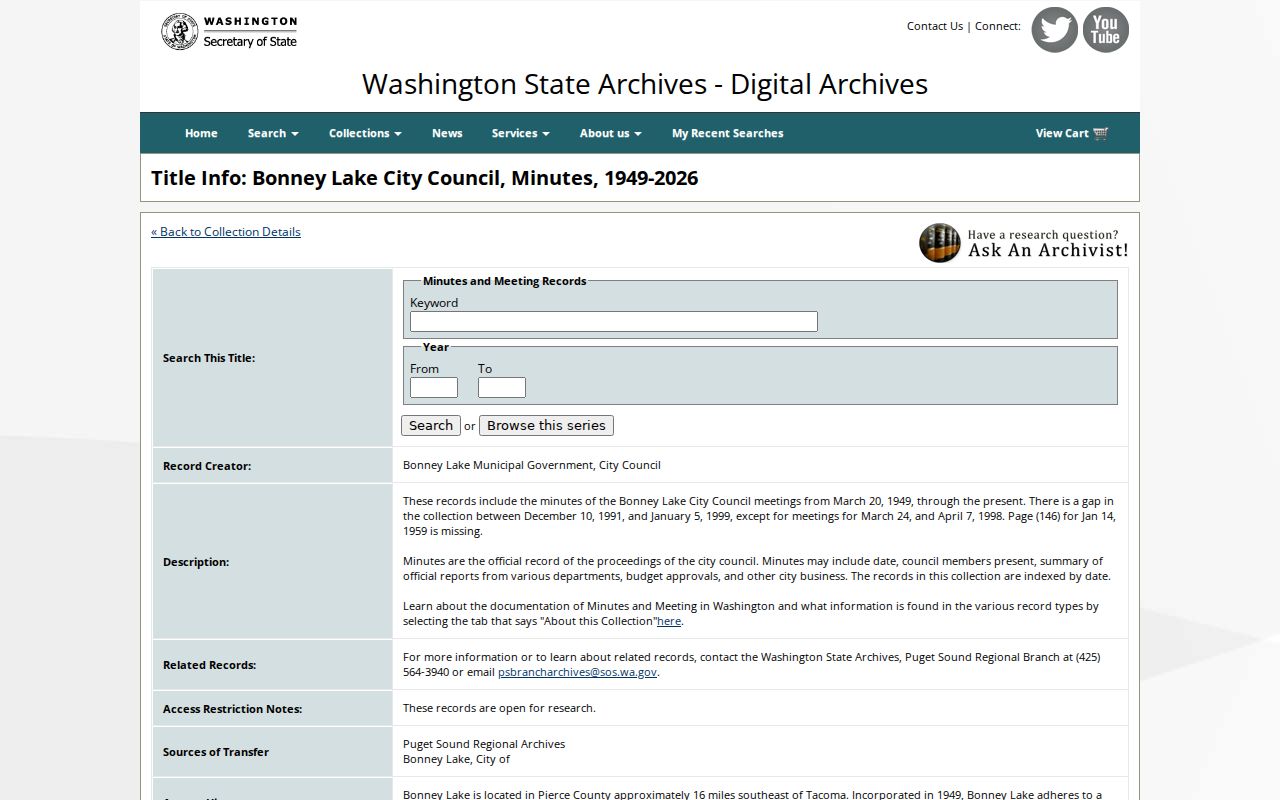
The archive view makes date-based browsing practical, but minutes are not resident rolls. Treat a name in public comment, an appointment, or a land-use matter as evidence of that event only.
Bonney Lake Records Move Online
A 2025 State Archives grant gives the local record story an unusual level of detail. Bonney Lake received $4,000 to digitize a backlog of ordinances, resolutions, council minutes, and planning minutes. The project describes about 21 cubic feet of records, 1,363 ordinances, 2,217 resolutions, and more than 2,000 meetings.
| Date | Record milestone |
|---|---|
| 1949 | Incorporation and start of the council-minutes series |
| 1967 | Start of planning-minute material named in the grant inventory |
| 2008 | City reports digitizing agendas, minutes, audio, resolutions, and ordinances in-house from this point |
| 2025 | State grant summary details the backlog digitization project |
This project improves access to civic names and events, but record types must stay distinct. Minutes summarize meetings. Ordinances enact code. Resolutions record a formal action or policy.
The grant inventory identifies ordinances 1-400 from microfilm and 901-1600 from scans, resolutions 200-700A from microfilm and 951-2650 from scans, council minutes from 1949-2007, and Planning Commission minutes from 1967-1993. Those ranges reveal gaps and format changes that a name search alone may hide. Record the collection title, meeting date, image or page number, and whether the source is minutes, an ordinance, a resolution, or audio. If the online index misses a likely item, browse the date range or ask the city records office about the undigitized portion.
Bonney Lake Historical Society Leads
The Greater Bonney Lake Historical Society offers the deepest local lead beyond city and library holdings. A 2024 report described about 5,500 cataloged items and roughly 65 boxes of Milotte documentary records and photographs. The society had moved material and was planning exhibits, archives, research access, and public programs.
No stable public catalog or fixed archive-room hours were located. Contact the society or city through current channels before expecting access. The Pierce County Historical Documents survey is another route: search by repository, collection, or keyword, then ask the holding institution about the item.
The survey spans photographs, public and institutional records, maps, plats, scrapbooks, clippings, diaries, letters, oral histories, and architectural drawings. Search a surname alongside Bonney Lake, a street, a school, a business, or an organization. Repository and collection filters can reveal material that a broad keyword misses. Access is set by the institution holding each item, so note the catalog description and contact that repository for viewing or copy rules.